



When employees use AI tools with corporate data, sensitive information leaks into AI backends, logs, and vendor chains in ways that enterprise security policies alone cannot prevent — and Dymium argues the only real fix is securing data before it reaches AI at all.
If your firm is on Snowflake, there’s a good chance you followed Snowflake’s recent release of new AI security products closely. Meant to complement and support the company’s Snowflake Horizon Catalog product for consistent AI context, security and governance, those improvements covered three core areas of AI security:
- Agent security for managing agent identity and AI posture, including prompt injection protection
- Data security focusing on sensitive data protection, data exfiltration protection and ransomware prevention
- Platform-level security with features like single sign-on (SSO)/provisioning, role-based access control (RBAC)/ABAC authorization and network security.
How should your firm bring these security tools into your AI security stack? At Dymium, we recommend using Snowflake’s robust new native products to protect permissioned uses of AI – and to use Dymium GhostAI for critical guardrails around inevitable shadow usage.
I’ll explain why in what follows. To see why we think that’s the best approach, let’s back up and understand why Snowflake presents such serious stakes for AI security to begin with.
The Scope of the Snowflake AI Risk
As the clearinghouse through which so much of corporate data flows, Snowflake is both crucial to corporate operations and an inherent vast surface for data leakage. It’s also a central point used by both LLMs and agentic AI – creating both enormous opportunities but also upping the AI risk.
For a sense of the degree to which both sensitive information and AI security exposure coincide in a Snowflake ecosystem, consider the examples in the chart below. They illustrate the types of sensitive data you’re likely to find across standard Snowflake surfaces, the risk inherent in major Snowflake surfaces, and the degree to which AI tools increase the risk of security incidents like unwanted data leakage or exfiltration.
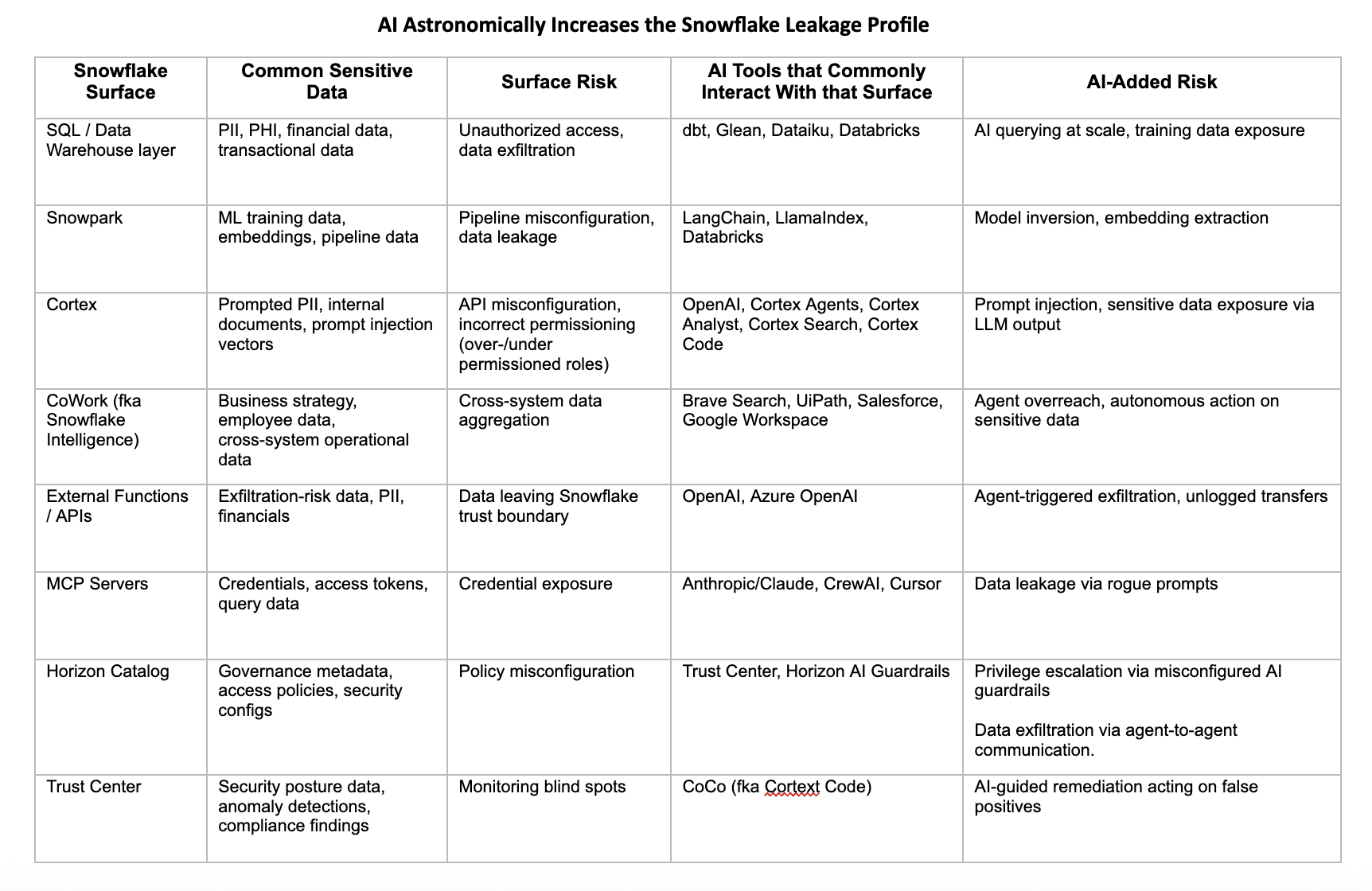
All of these risks are serious to consider within any AI use. But it’s crucial to consider the added threats specifically emerging from a specific source: unsanctioned use of AI.
The Shadow AI Threat for Snowflake Customers
As any IT leader will tell you, shadow AI looms large as an issue for any enterprise. Gartner research indicates that unsanctioned AI is prevalent across 69% of organizations, and will trigger security or compliance incidents in over 40% of enterprises by 2030.1
When it comes to Snowflake specifically, shadow AI can present a wide array of risks. For a few possible scenarios, consider the below:
- Data exfiltration: An employee downloads Snowflake data and uploads it to ChatGPT or another external LLM for ad hoc analysis, or pulls sensitive data into a personal Jupyter or Colab notebook — moving data into environments IT has no visibility into and the provider may retain.
- Uncontrolled AI outputs: AI-generated summaries, query results, or reports derived from Snowflake data are saved, shared, or published through unsanctioned channels — creating data exposure that begins after the query, not during.
- Shadow model training: Employees extract Snowflake data to fine-tune or train a local or third-party model – potentially permanently embedding the training information in the model itself.
When considering AI security tools for Snowflake, it’s important to be sure you’ve accounted for both the approved and shadow AI uses. To account for the full gamut, it’s helpful to think both in terms of defending data both within Snowflake environs, and beyond them. That’s where a Horizon Catalog + GhostAI approach comes in.
Use Horizon Catalog to Defend Within Snowflake Environs
Snowflake Horizon Catalog operates as a governance layer for Snowflake data usage. As such, it’s a powerful first line of defense against violations on or within Snowflake directly. For instance:
- If an agent is fetching sensitive data it shouldn't need, Horizon surfaces that anomalous behavior for review.
- If data is being moved suspiciously, Horizon detects unusual transfers to internal and external stages and flags them before they become a breach.
- If an employee is pulling more data than expected, Horizon identifies excessive downloads via the UI and can trigger an alert.
In each case, Horizon Catalog detects and cuts off threats acts – including AI threats – to data within the platform.
As a governance layer, Horizon Catalog is much less concerned with activity beyond Snowflake’s environs. While it does provide services to extend context and definitions across your broader data ecosystem, its security controls are focused on Snowflake directly. This is a crucial point to keep in mind when it comes to Snowflake-external uses of shadow AI.
To keep Snowflake data protected beyond Snowflake’s boundaries, you need Dymium GhostAI.
Use Dymium GhostAI to Solve for Shadow AI
Let’s go back to the scenario above of the user with permissioned access to download sensitive data. Since they’re allowed to download the sensitive information, they can readily upload it into any LLM or pass it on to the agent of their choice. Horizon Catalog may prevent restricted access for the wrong user downloading the information in the first place – but would not govern what happens to that data once it's downloaded by an approved employee or agent. That’s a crucial piece of the puzzle that governance teams must account for in the face of shadow AI.
Dymium GhostAI solves the shadow AI problem – by working at the data layer directly. Operating within your Snowflake instance, Dymium protects sensitive data by redacting or replacing it with a privacy-preserving alternative before any information leaves its secure environment. It cross-checks all data passing out of the system against company governance; then, it removes or replaces the sensitive information in real time. So, for instance, a user could download a Snowflake data set containing PII, direct an LLM to build a model or direct an agent to begin a sequence off of that data set – and still be fully in compliance with privacy rules, as GhostAI has redacted all sensitive information before the data leaves the Snowflake environment.
Employees or their agents are left with information that’s meaningful to an AI. Governance teams can rest assured that the sensitive data has been removed. In an era when organizations need to both strongly encourage and strictly control AI use, that’s a win-win.
Shadow AI is Here to Stay. Horizon Catalog + GhostAI is the Answer.
As many an IT or infosec leader can attest to, shadow AI is an unstoppable force across organizations. Given the vast benefits of fast AI adoption, employees’ embrace of AI is unarguably a positive development. But to ensure that the flood of AI use doesn’t come hand-in-hand with massive data leakage and exfiltration issues, Snowflake firms need maximum data security – both within Snowflake and beyond it. Snowflake Horizon Catalog provides that best-of-both worlds solution.
- To protect access to data within their Snowflake instance, we strongly recommend Horizon Catalog.
- To protect Snowflake data beyond Snowflake boundaries – and across Shadow AI – Dymium’s GhostAI is a must.
- To protect a heterogeneous data environment – where your data lives – for structured, unstructured and semi-structured data, Dymium is the obvious choice.
Want to learn how you can use Horizon Catalog + GhostAI to maximally secure your Snowflake data? Talk to Dymium to learn more and request a demo here.
1Gartner Identifies Critical GenAI Blind Spots That CIOs Must Urgently Address, November 19, 2025
.png)

.png)
.png)